Founder & Principal Facilitator
Payam
Psychedelic Somatic IFS & Medicine Carrier · US, UK & EU
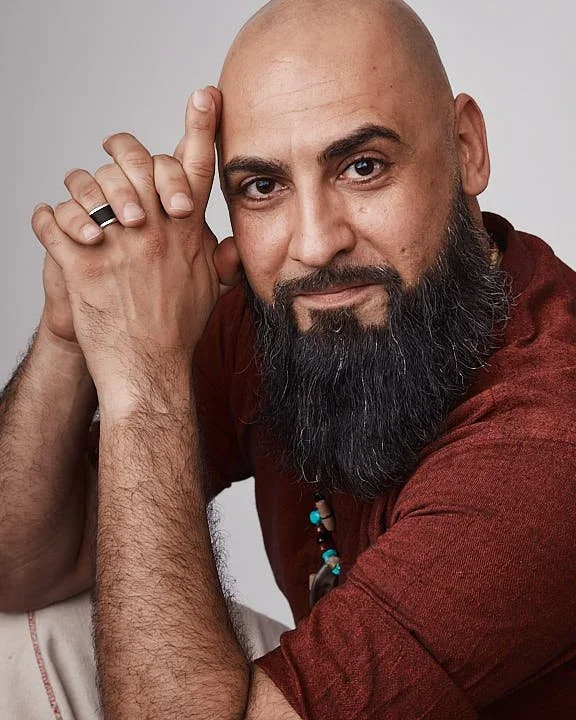
My work has essentially been about marrying and bridging the gap between Western evidence-based therapeutic models and shamanic medicine — and walking both paths.
Iran. War. Germany. New York.
Displacement as the first teacher.
Payam was born in Iran in the years before the revolution — a childhood interrupted first by political upheaval, then by war, then by displacement. His family took refuge in Germany before eventually immigrating to the United States, where he came of age across California and New York. Between these migrations, he was navigating something that had nothing to do with geography: severe childhood trauma, perpetrated by his father, that began in his earliest memories and shaped the bedrock of how he experienced himself and the world.
His father carried his own unmetabolised pain through opium — a pattern Payam has come to understand not with bitterness but with the particular clarity of someone who knows, from the inside, what it means to inherit weight that was never yours to carry.
Payam did not seek this lineage. It found him — inherited, with quiet irony, through his paternal grandmother, a healer whose gifts skipped a generation and arrived through suffering rather than instruction. What felt for years like a wound turned out to be a road — back toward something that had always been there, waiting for him to be ready to receive it.
The point where something
had to change.
Years of unaddressed trauma, built beneath a successful career in New York's creative world, reached the place that demanded something drastic. The conventional system had offered medications and brief, polite assessments. Twenty-minute appointments that resulted in prescriptions. Nothing had reached what was actually there. He got to the point where he wanted to stop living.
The medicines he now carries were his first teachers. Not sought out but found and initiated into. What they opened was not easy. It was also, finally, real — a clear view of the nature of his suffering, not as diagnosis but as a story that made complete sense. A puzzle that had been scattered and facing down, suddenly consolidated and turned right side up.
Building the language
that bridges two worlds.
Payam's first medicine journey had no proper care — no screening, no preparation, no support after ceremony. The shamanic initiation that followed gave him experience in the spirit realm — in being with the medicines, in navigating what they reveal, in learning to be present on multiple planes simultaneously. It did not give him the Western language to make it legible — to himself, or to the people he would eventually serve.
Ram Dass' teachings were the first — the spiritual understanding that seeded everything before the medicines confirmed it. Then Gabor Maté's work, who named what he had been living. Then Richard Schwartz and Chris Burris, whose Internal Family Systems gave him the map. Then Somatic Experiencing, which gave him the body. To this he brought twenty years of embodied practice — yoga, martial arts, acupressure, Thai massage — disciplines that had been quietly building the same capacity the medicines were asking of him. This became the synthesis: two decades of training in both worlds simultaneously, never settling into either, always building the capacity to stand between them and translate.
Not a shaman —
not a therapist.
He does not call himself a shaman — he does not claim a lineage in the way that term traditionally requires. He does not call himself a therapist. He holds no license, does not pathologise, and does not call people patients. He calls them Seekers — because they are seeking, and because that word carries respect for the sovereignty of the person and the seriousness of what they are undertaking.
What he is, as precisely as language allows: a medicine carrier and psycho-spiritual practitioner who has been genuinely initiated into both worlds — the shamanic and the therapeutic — and who has spent twenty years building the capacity to bring both to bear on a single human being in a single room, with medicines that tell the truth about what is actually there. That is not a credential. It is a life's work.
What the field Recognizes
The credentialing
no institution can confer
There is a form of recognition that arrives not through application, but through the work itself.
Psychiatrists, physicians, therapists, and facilitators internationally refer people to Payam when conventional approaches have not fully reached the depth of what is asking to be healed — not as a rejection of those disciplines, but as an acknowledgment that certain dimensions of human suffering, transformation, and spiritual emergence often require a broader framework of understanding.
Many of these professionals remain actively involved in the process, collaborating in support of shared patients and seeking ways to responsibly integrate this work into their own clinical and therapeutic practices. Some consult on difficult or unconventional cases. Others come to better understand experiences arising in their own treatment rooms that traditional models alone do not fully explain.
Facilitators working with these medicines seek mentorship and guidance when the complexity of a case exceeds the limits of technique alone. And many come for their own healing as well — because those who understand the depth, responsibility, and consequences of this work firsthand often recognize the importance of being held within it themselves.
None of this was strategically built. It accumulated quietly through years of work, through relationships, through referrals, and through outcomes that spoke for themselves. There is no credential that fully explains it. Only the work itself, and what it has made possible in the lives of those who have entered it.
Training & Practice